Je t'aime: The Synastry of Serge Gainsbourg & Jane Birkin
Few couples have captured the spirit of an era with as much provocative charm and artistic synergy as Serge Gainsbourg and Jane Birkin. He was the gravel-voiced poet laureate of French pop, a notorious provocateur with a love for chess, cigarettes, and transgressive art. She was the English ingénue, whose ethereal beauty and breathy vocals became iconic. Together, for over a decade, they were the epicentre of Parisian cool—a whirlwind romance that produced a daughter, Charlotte, scandalous headlines, and timeless music, most notably the globally controversial and wildly successful "Je t'aime... moi non plus." Their synastry chart reveals the potent astrological blend of stability, illusion, and fated connection that defined their legendary love affair.
*Note: The AI interpretation below was generated from the complete synastry chart data. For clarity, the list above is truncated from the full chart of over 20 aspects.
ASTROLOGUS Synastry Interpretation
Core Dynamics (Sun Aspects):
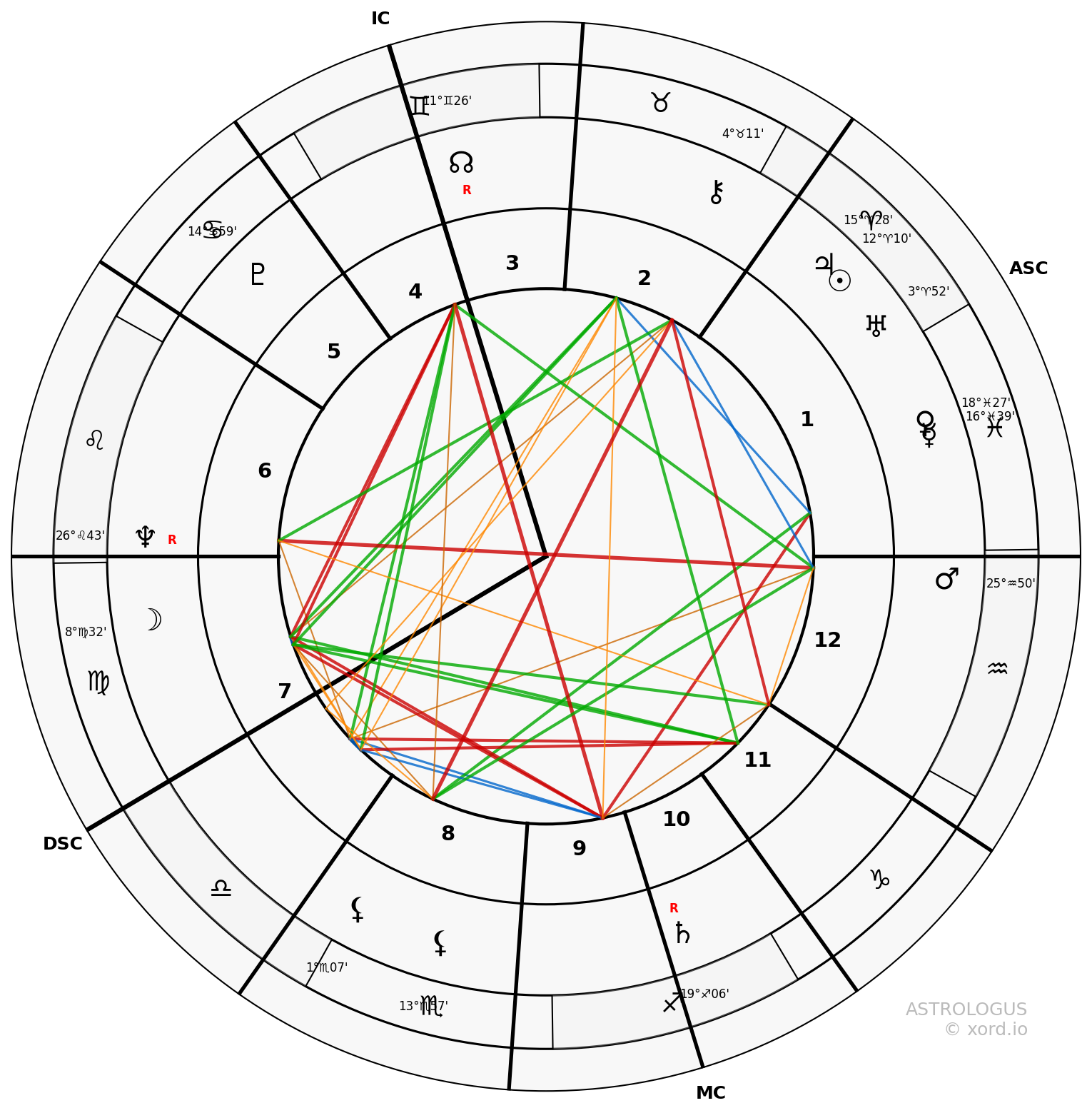
The Sun's interactions are central. A Sun-Saturn trine (3.83°) provides a stabilizing influence and mutual respect. This is countered by a Sun-Neptune opposition (1.61°), indicating a high potential for idealization, confusion, or creative inspiration. A powerful Sun-Pluto trine (0.99°) suggests an intense, transformative connection, while a very tight Sun-True Node sextile (0.49°) points to a relationship aligned with a shared sense of purpose or destiny.
Communication and Affection (Mercury & Venus Aspects):
Communication is complex, with a Moon-Mercury square suggesting emotional clashes with intellect. However, an extremely tight Mercury-Jupiter trine (0.48°) indicates expansive, optimistic, and growth-oriented conversations. Affection is marked by a Venus-Jupiter trine (1.32°), enhancing joy and generosity, but a tight Venus-Uranus square (1.19°) introduces unpredictability and potential instability into romantic expressions.
Summary: The synastry highlights a blend of both harmonious and tense dynamics. Key themes are stability vs. illusion (Sun-Saturn vs. Sun-Neptune), destined transformation (Sun-Pluto/Node), and joyful but unpredictable affection (Venus-Jupiter vs. Venus-Uranus). The presence of many tight orbs suggests these influences were strongly felt, contributing significantly to a relationship defined by creative depth, romantic volatility, and an underlying, fated connection.
The Sun of one soul finds a harmonious trine with Saturn, like a wise mentor guiding a hero. Yet, this Sun's opposition to Neptune weaves a misty veil of dreams and illusions, an echo of Odysseus navigating the siren's call. Pluto's trine enriches this narrative with the power of transformation—Persephone's descent and rise, promising renewal. A sextile to the True Node suggests a fated connection, as if two travelers find themselves on a converging road, led by the stars.
The Dance of Heart and Mind:
The Moon's square to Mercury and its opposition to Venus paints scenes of emotional turbulence. The Moon, keeper of feeling, clashes with Mercury's analytical mind—a push-pull between heart and head. Venus, goddess of love, opposing the Moon hints at emotional tensions that require deep empathy to resolve. It is Psyche's challenge to trust and understand, a quest for harmony between logic, love, and emotion.
Summary: In this celestial tapestry, the relationship is one of profound lessons and transformative potential. The mythic symbols speak of growth through challenge and unity in diversity, a cosmic narrative where each aspect is a chapter in their shared story—a tale of the Sun's journey through the realms of Saturn's wisdom, Neptune's dreams, and Pluto's transformative embrace.
The Alchemical Foundation:
A Sun-Saturn trine provides a harmonious flow of stability, indicating a relationship built on mutual respect. Saturn, the great taskmaster, supports the Sun's creative drive with endurance. This is amplified by a Sun-True Node sextile, a guiding beacon suggesting a shared destiny where the Sun illuminates the path toward mutual fulfillment.
The Volatile Elixirs:
A Venus-Jupiter trine is a blessing, blending the two benefics to create joy and abundance. However, challenging squares (Moon-Mercury) and oppositions (Venus-Moon, Mercury-Moon) introduce emotional and communicative friction. These aspects create a push-pull dynamic, forcing both to explore and understand each other's inner worlds to resolve tension.
The Crucible of Healing:
A TrueLilith-Chiron conjunction suggests a powerful healing potential. By confronting primal fears and vulnerabilities (Lilith), both can achieve profound healing (Chiron). This is deepened by a MeanLilith-Venus conjunction, indicating an intense, transformative attraction that challenges traditional notions of love and demands raw authenticity.
Summary: This synastry is full of potential, where the interplay of structure and spontaneity, challenge and harmony, creates a dynamic and transformative connection. The celestial forces encourage both individuals to grow, heal, and evolve through a union that is both a stable foundation and a volatile crucible.
Serge Gainsbourg, who had a relationship with Jane Birkin in the 1960s, was often a provocative figure. Photograph: Reg Lancaster/Getty Images
The first meeting between Jane Birkin, the English actress, and Serge Gainsbourg, the revered French musician, was reportedly frosty. Cast opposite each other in the 1969 film *Slogan*, Birkin was initially put off by his arrogance. Yet, that initial dislike soon melted into one of the 20th century's most iconic and tempestuous love affairs. Their creative and romantic partnership quickly came to define the libertine cool of the late 60s and 70s, cemented by their scandalous duet, "Je t'aime... moi non plus"—a song Gainsbourg had originally written for Brigitte Bardot, but which Birkin's breathy, intimate vocals made legendary.
Their life together was a public spectacle of passion and provocation. Gainsbourg, a notorious drinker and smoker, would lead them on escapades to transvestite nightclubs, while Birkin, with her trademark wicker basket, would playfully slip monogrammed dinnerware from Maxim's into her bag. Despite the turbulence and their eventual separation in 1980, their bond remained profound. It was a connection built on a unique blend of artistic respect, deep affection, and a shared flair for the theatrical. When Gainsbourg died in 1991, Birkin placed her beloved childhood stuffed monkey, "Munkey," alongside him in his coffin, a final, tender gesture to the man who had so completely shaped her life.
Speak to the Stars: A Dialogue with The Symbolist
This is a sample of a "Speak to the Stars" session. With a full ASTROLOGUS license, anyone can engage in these dialogues, ask direct questions, and receive starry knowledge from our AI personas in the Dashboard.
You: What you wrote, "The image of two souls, like celestial dancers, moving through the constellations... concludes this reading," is pure poetry. But what aspects are truly, I mean truly, the key components of this relationship?
The Symbolist: In the celestial symphony of this synastry, several key aspects resonate with profound significance. A Sun-Saturn trine forms the backbone of stability and grounded growth. This is challenged by a Sun-Neptune opposition, the dance of reality and illusion. A Sun-Sextile-True Node suggests a karmic purpose, a guiding star pulling them toward a common mission. An intense Venus-Uranus square introduces an electric, unpredictable energy, suggesting a relationship that thrives on change and excitement, while a Moon-Venus opposition infuses emotional complexity, creating a dynamic of learning where lovers must balance heart and desire.
You: If I tell you that this is a Serge Gainsbourg and Jane Birkin synastry. What would you say?
The Symbolist: Then the synastry becomes a living myth. The Sun-Saturn trine is the bedrock of their long-term artistic and personal bond, a foundation of mutual respect amidst the chaos. The Sun-Neptune opposition is the enchanting veil of their shared creativity, the allure of fantasy, and the blurred lines between their love and their art. The True Node sextile speaks to their destined, karmic meeting that propelled them into a shared horizon. The Venus-Uranus square is the electric, volatile, and unpredictable nature of their public and private passion, while the Moon-Venus opposition reflects the intense and tumultuous nature of their love—the tale of Eros and Psyche navigating the stormy seas of desire and devotion.
The Synastry Chart of Serge Gainsbourg & Jane Birkin
Disclaimer: This is for exploration and symbolic insight only. ASTROLOGUS offers rigorous interpretations, but no claim is made beyond the symbolic and artistic.
It's not astrology predicting your life. It's you recognizing your life inside astrology.
About the Author: Cesare di Monte Calvi is the esoteric historian behind
The Raven’s Enigma
and lead mythographer of the ASTROLOGUS project. His work bridges Renaissance gnosis with digital cartography, reviving the lost grammar of the stars for a post-algorithmic age.
You've seen their charts. Now discover your own. A one-time purchase of $4.99 unlocks the ASTROLOGUS platform and 50 readings across all AI personas.
Only $4.99
One-time purchase • Lifetime access • 50 readings included
Stardust Memories: Save and revisit all your readings