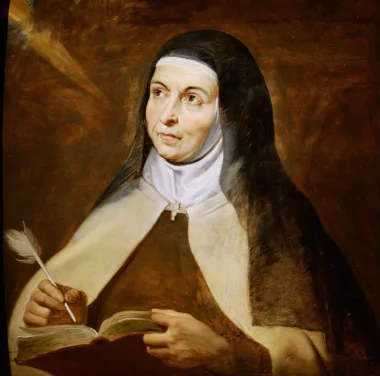
Teresa of Ávila (1515–1582) was a Spanish noblewoman who became a Carmelite nun, a prominent mystic, and a seminal writer of the Counter-Reformation. Her profound experiences of spiritual ecstasy and divine union fueled a tireless drive to reform her religious order, leading to the founding of the Discalced Carmelites. Canonized as a saint and later named a Doctor of the Church, her works on contemplative prayer remain cornerstones of Christian mysticism.
You've seen their charts. Now discover your own. A one-time purchase of $4.99 unlocks the ASTROLOGUS platform and 50 readings across all AI personas.
Only $4.99
One-time purchase • Lifetime access • 50 readings included
Stardust Memories: Save and revisit all your readings
✅ 30-Day Money-Back Guarantee
Changed your mind?
⚡ Instant Dashboard Access • ✅ Lifetime License
All cryptocurrency sales are final
The Symbolist Interpretation
Sun (21) semisextile Mercury (24):
In the realm where the fiery light of the Sun meets the silvery whisper of Mercury, an alchemical dance is underway. The Sun, sovereign luminary of the day, casts its golden rays upon Mercury, the fleet-footed messenger of the gods. Here, at the border of realms, Hermes takes whispers from Apollo, translating divine insight into the language of mortals. It is a fleeting touch, a hint of color on the horizon where clarity might just slip into a poet’s metaphor, half-seen and half-imagined.
Mars (7) sextile Jupiter (3):
In the oceanic currents of the Piscean sea, Mars, the ancient warrior tempered by Neptune's waters, stretches forth a hand to Jupiter glistening atop its mountain of Capricornian stone. The sextile is a bridge of potential, where action meets expansion. It is as if Heracles himself is aided by Zeus—who throws down bolts of opportunity—creating pathways for conquest not through might alone, but through strategic wisdom and the benevolent guidance of fortune.
Venus (2) opposite Moon (9):
Through the hallowed skies, where Venus, the beloved goddess clothed in morning dew, gazes across the heavens to the Moon, silver orb of Luna's embrace in Libra’s balance scales. This tense opposition is a heartbroken song, where Aphrodite's yearning meets the Moon's cold reflection, a dance of longing that touches upon the inadequacies of desire. The night sky echoes with the pull of opposites that attract and repel, a cosmic reminder that love and emotion must coexist despite their differences, carving paths of deeply felt duality.
Mars (7) quincunx Moon (9):
Mars, the steel-clad warrior, finds an ethereal enigma in the lunar goddess shimmering from Libra’s constellation. The quincunx here is an awkward tango—a dance between resolve and receptivity, between ambition’s fire and feeling’s mirror. Mars wishes for action and conquest; Luna seeks harmony and peace. It’s as if Ares wrestles with Selene under a starry canopy, adjusting steps, learning to move within each other's rhythms—a testament to growth through discomfort in their celestial choreography.
Summary: In this chart, there are whispers of divine resonance at every cosmic crossroad. The stars align and misalign like the pages of a celestial epic, weaving tales of gods and goddesses locked in eternal storytelling. We have dance partners in a sextile, contrasting players in opposition, peculiar partners in a quincunx, and an alchemical exchange in the semisextile. Alone, each aspect throbs with its own symbolism; united, they weave a narrative as rich and intricate as the nuptial flight of myths across the heavens. And so, with thirteen aspects and a lone T-square of Venus-Jupiter-Moon, the fates spin as ever, beckoning us to dwell in their eternal mystery and to ponder the cosmos' storytelling with eyes wide like a poet's heart.
The Alchemist Interpretation
According to the true mandates of classical astrology, the natal chart for March 28, 1515, must be interpreted ignoring all forbidden content such as Uranus, Neptune, Pluto, quincunxes, and semisextiles. Let us delve into the chart respecting only the Ptolemaic aspects. Below follows the interpretation of aspects under classical astrological doctrine:
Venus (2° in Aries) opposite Moon (9° in Libra):
This opposition concerns the balance between one's desires and affections (Venus) and the emotional responses and domestic focus (Moon). Venus, devoid of dignity in Aries, is impelled into action but met with the Lunar reflective nature in Libra, highlighting the tension between personal wants and relational harmony.
Mars (7° in Pisces) sextile Jupiter (3° in Capricorn):
Mars, in this mutable watery disposition, communicates harmoniously with Jupiter in its fall in Capricorn through a sextile. This denotes sagacity in action and drive towards the attainment of goals. Jupiter, the greater benefic, offers sagely guidance from the structure of earthy Capricorn.
Summary: In this natal chart, the opposition of Venus opposite Moon signals a fundamental tension between personal desires and emotional receptivity or public engagement. Meanwhile, Mars sextile Jupiter facilitates positive interaction between ambition and expanse, hinting towards the effective utilization of resources and opportunities. The diurnal emphasis with a strong Solar presence and the essential dignity of these planets provide a basis for choleric determination balanced with sanguine optimism.
The Diagnostician Interpretation
Venus (2) opposite Moon (9):
This creates a tension axis.
Mars (7) sextile Jupiter (3):
This indirect connectivity facet appears at a wide relation distance.
Sun (21) semisextile Mercury (24):
Highlights a near-communication bridge at a tight angle of 2°14'.
Mars (7) quincunx Moon (9):
Structural angle of adjustment.
Chart Features:
T-square: Venus-Jupiter-Moon composite aspect forming a triangular tension pattern.
Summary: The chart contains a composite of varied aspect structures with a notable lack of clusters involving traditional hard aspects like squares. The presence of quincunxes indicates areas requiring adjustment without direct conflict. Venus and Moon are crucial in the conflict axis, given their opposition and inclusion in the T-square. Mars figures prominently in non-square aspects, linking indirectly to other planetary influences. The configuration entails both loose and tight aspects, with none too rigid, reflecting complexity in geometric distribution.
Saint Teresa of Ávila (1515-1582), a devotional painting by Peter Paul Rubens, c. 1615. Housed in the Kunsthistorisches Museum, Vienna.
Born Teresa de Cepeda y Ahumada in Castile, Spain, Teresa of Ávila entered the Carmelite Order in 1535. Her early years as a nun were conventional until a period of severe illness, which left her paralyzed for three years, catalyzed a profound spiritual transformation. This crisis culminated in a life-altering vision of the "sorely wounded Christ," which ignited within her a fervent desire for a deeper, more authentic spiritual life and a mission to reform the world around her.
Inspired by her ecstatic visions, Teresa embarked on the formidable task of reforming the Carmelite Order, advocating for a return to a more austere and contemplative "primitive rule." Gathering supporters, she founded the first convent of Discalced (or "shoeless") Carmelites, a movement that emphasized poverty, silence, and prayer. From 1560 until her death, she traveled tirelessly across Spain, establishing new convents and, with the help of her contemporary St. John of the Cross, extending the reform to the male branch of the order.
Beyond her work as a reformer, Teresa left an indelible legacy as one of the great writers on Christian mysticism. Her major works, including The Way of Perfection and The Interior Castle, provide a masterful and deeply personal cartography of the soul's journey toward divine union. For her immense contributions, she was canonized in 1622 and, in 1970, was declared a Doctor of the Church, a prestigious title she shares with other towering figures of Christian mysticism like Catherine of Siena.
Our relentless, rather agonizing need for meaning is our doom and our destiny. Astrology exists because it perfectly serves that fundamental, abnormal human need that a rational world denies us. Read "Why Astrology Exists When It Shouldn’t".
Disclaimer: This is for exploration and symbolic insight only. ASTROLOGUS offers rigorous interpretations, but no claim is made beyond the symbolic and artistic.
It's not astrology predicting your life. It's you recognizing your life inside astrology.
About the Author: Cesare di Monte Calvi is the esoteric historian behind
The Raven’s Enigma
and lead mythographer of the ASTROLOGUS project. His work bridges Renaissance gnosis with digital cartography, reviving the lost grammar of the stars for a post-algorithmic age.